





Head of Marketing at 10Duke.
Connect with me on LinkedIn.
Most software vendors don't think of themselves as having a licensing strategy. They have something that works well enough: a key generator, a spreadsheet, a homegrown activation server. It's not broken, so it's not on the roadmap.
But licensing maturity isn't binary; it's a spectrum. And where your business sits on it has a direct, measurable effect on three things: the revenue you actually capture, the cost of running your business, and how fast you can move when the market shifts.
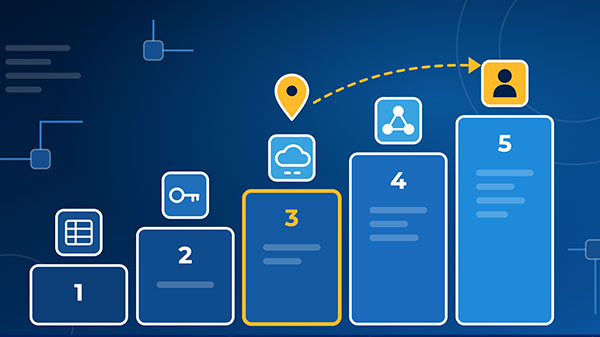
We built a five-stage model to help ISVs pinpoint exactly where they stand, drawn from patterns we've seen across hundreds of software businesses. Most self-identify at Level 2 or 3, and most significantly underestimate what staying there is costing them. Here's the full picture.

Level 1: Manual and fragile
Licenses are issued by hand: spreadsheets, email threads, static keys distributed one at a time. There's no central record of who has what. Enforcement doesn't really exist, and when you need to audit usage, you're asking the customer to tell you.
Level 2: Keys and servers
You've implemented an actual licensing system, typically a key generator paired with a local activation mechanism or an on-premise license server. Licenses are tracked, at least partially. But the system is rigid: changing a customer's entitlements takes manual intervention, trial-to-paid conversion is a process instead of a moment, and every platform migration creates a fresh support queue.
Level 3: Cloud-connected, but patchwork
Some of your licensing infrastructure has moved to the cloud, or you've bolted on a SaaS tool. Activation is faster and you have partial visibility into who's licensed. But nothing is integrated: your CRM doesn't talk to your licensing layer, your ecommerce platform sends payments and licenses into separate silos, and the usage data you do have isn't actionable.
Level 4: Integrated and visible
Your licensing system connects to your CRM and ecommerce platform. Issuance, renewal, and revocation happen automatically. You can see in real time who's using what, and your customer success team actually uses that data. You can offer trials, add modules, or change a plan without touching the backend. Revenue leakage is largely closed. The gap left is that your licensing models are still relatively fixed. Moving to usage-based or feature-gated pricing would mean significant rework.
Level 5: Identity-based, usage-informed
Licensing is tied to verified user identity, not devices or keys. Every login is a licensing event. You can see feature-level usage across your entire customer base in real time. Pricing models such as subscription, floating, pay-per-use, and feature-gated can be configured and changed without an engineering sprint. You know which features drive renewal and which go unused. At this level, licensing stops being infrastructure and starts being a growth asset.
The real gap isn't technology
Here's the part that surprises most product leaders: the distance between level 3 and 5 isn't primarily a technology gap, it's actually a decision gap. The underlying platforms to get there exist and are available today. What's usually missing is the internal case for change, and a clear-eyed look at what staying at level 3 is actually costing across revenue, engineering time, and the deals your current model can't support.
Where are you?
If you read through those five levels and landed on level 2 or 3, you're in the same place most fast-growing ISVs are. The question worth asking isn't whether to move, it's what staying there is costing you right now, and what it would take to close the gap.
 We break down exactly that (the hidden costs at each level, the build vs. buy framework, and a practical playbook for making the transition) in our full guide, Stop Building Licensing. Start Growing Revenue.


