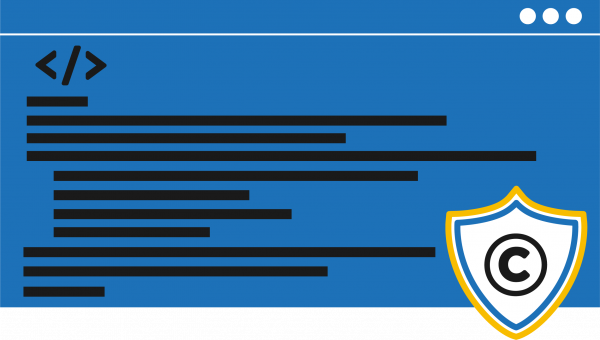
Software copyright is the legal protection that gives software creators exclusive rights over their code. Copyright applies automatically when software is written, prohibiting unauthorised copying, distribution, or modification of the code.

For software businesses, software copyright is the foundation of IP protection - but it must be enforced through software licensing.


What Does Copyright Protect in Software?

Copyright protects the expression of software, meaning the written source code and compiled code. It does not protect ideas, algorithms, or general functionality.

Historically, computer programs were not protected by copyright because until 1974 computer programs were not viewed as fixed, tangible objects. However, in 1983 traditional copyright law was extended to include machine-readable software and the Copyright Act awarded computer programs the same copyright status as literary works. While many of the same legal principles and policies apply, there are a number of distinct issues that arise with software copyright.


Copyright and Software Licensing

You automatically own the copyright for any software you develop. Once you’ve finished coding it you don’t have to do anything to own it. However, enforcing your legal rights on the software you developed is another matter.

Copyright establishes ownership. Software licensing defines how that copyright may be exercised by users.

Licenses specify who can use software, for how long, and under what conditions, while ownership remains with the copyright holder.

You could say that software licensing is how you turn code into revenue.

Learn how license models work in our guide to licensing models.


Enforcing Software Copyright in Practice

Unfortunately, if all you do is just ask politely that end users comply with the software license terms, chances are you’re giving away your software product to be used for free. Therefore, you need to have a mechanism to enforce license compliance in some way.

One such mechanism is called software licensing. The basic idea is that the end users get easy access to the software product, while the ownership rights remain with the software developer.

In practice, software licensing enables the developer to monetize the software product by limiting access to it so that only those who have paid and obtained a valid license can use the application.

This is where modern licensing platforms such as 10Duke come in. With 10Duke, software vendors can enforce license compliance using identity-based licensing that ensures only authorised, paying users can access and use the software.

If you’re looking to enforce your software copyright, book a call with one of our licensing consultants.

Key Summary

1What is meant by software copyright?
Software copyright is a legal right granting the creator exclusive rights to use, distribute, and modify the software.
2Can software be copyrighted?
Yes, software can be copyrighted in most countries as it is typically considered a literary work under copyright law
3What is an example of copyright in software?
An example of software copyright is Microsoft Office suite, which includes restrictions on unauthorized copying, distribution, and modification of its various applications like Word, Excel, and PowerPoint.
4How long does copyright in software last?
Copyright in software generally lasts for the life of the author plus 70 years in many countries, though exact durations can vary by jurisdiction.
5Why is it important for developers to understand copyright and software licenses?
Understanding copyright and software licenses helps developers protect their intellectual property, ensure legal compliance, and manage how their software is used and distributed.
 

Unlock 15-35% more license revenue  from existing customers

10Duke is a best-in-class software monetization platform designed for modern software businesses.

Improve how you license and monetize your software products.
Licensing Lab Blog

13th October 2026

Behind the License: Meet Hamish Smith

Meet Hamish Smith, Senior Software Architect and Team Leader in 10Duke’s New Zealand office. He talks about how a degree in Ecology shaped his systems thinking, the work of making licensing complexity simple, and why usage-based licensing is coming back.
9th October 2026

Rethinking Node-Locked Licensing

Node-locked licensing has been the default for desktop software for decades. But hybrid work and constant hardware refreshes mean machines no longer stand still. Locking a license to one machine permanently now costs ISVs more in support and lost revenue than it protects.
22nd September 2026

8 Software Piracy Statistics Every ISV Should Know in 2026

See what software piracy and license misuse are really costing ISVs in 2026, from malware-laced cracks to $500K+ compliance bills, and why homegrown licensing systems leave vendors with no way to see any of it happening.